JVS Toronto

DONATE
  • About
    • Our Leadership
    • Our Funders & Donors
    • Annual Reports & Financials
    • Service Interruption Notices
    • FAQs
  • Find a Job
    • Career Development and Job Search Support
    • Disability Services
      • RiseAbility
    • Jewish Community Services
    • Newcomer Services
    • Youth Services
    • Job Search Resources
    • Hiring Events
  • Events
    • Hiring Events
    • Interview Skills
    • Job Search Skills
    • LinkedIn Tips
    • Networking & Info Sessions
    • Newcomers
    • Resume Help
    • Youth Events
  • Employers
  • Pre-Arrival
  • Give Back
    • Donate
    • Volunteering and Mentoring
  • Blog
  • Contact

March 4, 2026 Leave a Comment

How to Succeed at Job Fairs

A step-by-step guide on how to leave a lasting impression on employers

It can be difficult for job seekers to stand out amongst other applicants when all an employer has to evaluate them on is a resume. While a resume is an important document that includes relevant information like experience and technical skills, it doesn’t showcase a person’s interpersonal skills or personality, which can only be done in a one-on-one conversation.

Job fairs offer an excellent opportunity for job seekers to meet directly with and impress employers before they even submit a resume. Employers who attend job fairs set up tables which are staffed by recruiters willing to answer questions, discuss open job roles, and accept resumes. A successful conversation with a recruiter or even with a fellow job seeker can create an important professional connection that could lead to future job opportunities.

Speaking directly with employers – and the preparation required beforehand – can feel a bit overwhelming. For that reason, JVS Toronto has created a helpful guide on how to succeed at a job fair.


Before the Job Fair: Get Prepared

Step 1: Read the job advert very carefully

This document or webpage will include important information, such as which employers will be attending the job fair, location, time, and details on how to register.

Step 2: Research the employers

Learn more the employers to properly assess which ones meet your career goals and to create thoughtful questions to include in your conversations with recruiters. Remember to avoid asking any questions that are answered in the job description or on the company’s website.

Step 3: Prepare your resume

Update your resume and LinkedIn profile prior to attending the job fair. (Be sure to include your LinkedIn profile’s URL in your resume.) Print multiple copies of your resume to hand out at the job fair, and even think about creating resumes tailored to the employers that interest you the most.

Step 4: Write an elevator pitch

Create a short introductory statement – about 30-60 seconds long when read out loud – that highlights your key skills, experiences, and suitability for an employer’s job openings.

Step 5: Practice makes perfect

Practice delivering your elevator pitch and answering mock interview questions to better prepare yourself for speaking with recruiters.

AI tools can be useful when preparing for a job fair, offering assistance with crafting an elevator pitch, practice interview questions, or organizing your research on employers. But remember, AI is merely a tool, and it’s your personal touch that will leave a lasting and meaningful impression on employers.


During the Job Fair: Make Connections

Step 1: Before you arrive

You want to appear clean and professional when meeting the recruiters. Make sure you are well-groomed, wearing professional attire, and have a comfortable pair of shoes. (Job fairs involve lots of standing and walking.) The copies of your resume and employer questions should be stored neatly inside a folder or portfolio.

Step 2: Arriving at the job fair and approaching employers

Arriving early to beat the long lines and speak with recruiters at the beginning of the fair, which is when they’ll have the most energy. Approach recruiters with confidence by smiling, making eye contact, giving a firm handshake, and introducing yourself clearly (the elevator pitch).

Step 3: Speaking with recruiters

Use this opportunity to learn more about the recruiter’s employer, showcase your experience and skills, and create important professional connections that could help in your job search.

Here are a few helpful tips to keep in mind when speaking with recruiters:

  • Keep your mobile phone on ‘silent.’
  • Maintain eye contact during your conversation.
  • Don’t talk about salary or benefits as this is merely an introductory conversation.
  • See if they’re open to connecting on LinkedIn
  • Have a LinkedIn QR code handy to easily share your profile.
  • Ask the thoughtful questions you prepared in advance.
  • Keep the conversation short and to the point.

If the conversation is going well, but the recruiter has a line-up of people waiting to speak with them, ask if they’d like to continue your chat over a brief, 15–30-minute phone or video call. Once you’ve finished speaking with a recruiter, take notes on job names, job titles, and any other important details from your conversation.

Step 4: Network with your fellow job seekers

Meet your peers and learn from their experiences. While they may not be employers, networking with the other people at the job fair could lead to unexpected career opportunities.


After the Job Fair: Follow Up

Step 1: Apply promptly

If you discussed a specific job role with a recruiter, make sure to submit your application as soon as possible.

Step 2: Send follow-up emails

Reach out to the recruiters you spoke with to express your gratitude for their time and continued interest in any open job roles. Keep the email short and reference your conversation from the job fair.

Step 3: Follow-up on LinkedIn

Send connection requests to the recruiters and job seekers with whom you spoke. When you send the connection request, include a brief message that references your conversation at the job fair.

Step 4: Reflect on your experience

Look back on the conversations you had with the recruiters, thinking about what went well and what you could improve on.

All of these follow-up activities should be completed within 24-48 hours after the job fair while the conversations you had with the recruiters and other job seekers are still fresh in their minds.

Job fairs are a powerful tool in a job search, offering job seekers a great opportunity to learn about the jobs available in their community. Not every conversation will lead to a job, but every connection made strengthens their professional network.


Click here to access JVS Toronto’s events calendar to see upcoming job fairs.
By Donna Chabot Filed Under: Career Voice: Blog, News & Highlights Tagged With: careers, employers, employment, find work, hiring events, interview, interview questions, interviewing, interviews, job fairs, job interview, job interviews, job search, job search advice, networking, resume

December 10, 2024

Charting Your Career Path (In-Person)

Discover your career potential, and begin charting a career path

This engaging workshop will help you set SMART goals for your job search, define your career objectives, and create a practical job search action plan. We’ll review how to develop a focused strategy, stay organized, and maintain motivation as you navigate the job market in 2025. Additionally, we’ll cover essential business etiquette tips to help you stand out and effectively get back to employment. This is an in-person event located in Markham.

To register for the event, please contact [email protected] or (905) 470.9675 ext. 3407.

By Donna Chabot Tagged With: Career Exploration, career-decision-making, careers, employment, find work, job search, jobsearch, on the job, soft skills

September 30, 2024 Leave a Comment

JVS Toronto’s 77th Annual General Meeting

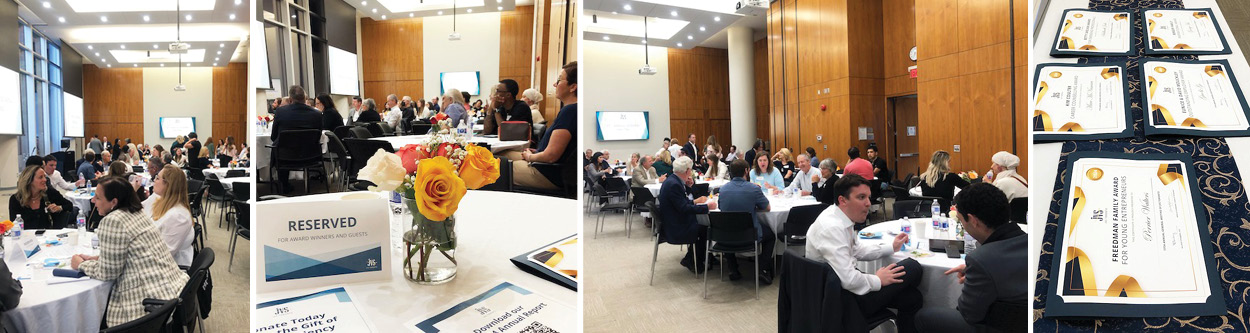
We would like to extend our heartfelt thanks to everyone who attended JVS Toronto’s 77th Annual General Meeting held on September 25th. It was truly great to come together and celebrate the achievements we’ve made over the past year.

The AGM began with a formal business portion, and our CEO, Allison Steinberg, highlighted the incredible resilience and dedication of our staff, volunteers, donors, and community partners in supporting over 16,000 clients and over 6,800 employers this past year. It’s been a challenging time for many, and our collective efforts have continued to make a real impact in the lives of those we serve.

Congratulations to this year’s award recipients!

One of the most meaningful parts of the evening was the awards ceremony, where we recognized the remarkable accomplishments of our clients, volunteers, and employers. Congratulations to all our award recipients.

Julene Powell, Recipient of the Joseph Skolnik Award for New Canadians. Accepted the award via video.

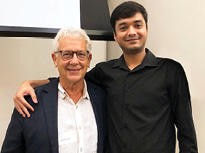
Siddharth Joshi, Recipient of the Betty Skolnik Award for Emerging Professionals. Pictured with Bill Skolnik.

Perrier Walters, Recipient of the Freedman Family Award for Young Entrepreneurs. Pictured with Nancy Freedman.

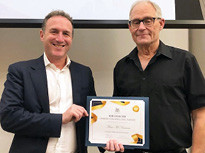
Marc McNamara, Recipient of the Kim Coulter Career Counselling Award. Pictured with Jonathan Kopman.

Pelmen Foods, Recipient of the Eunice & David Mouckley Employer Award. Accepted the award via video.

Give and Go, Recipient of the Eunice & David Mouckley Employer Award. Pictured with Jeff Mouckley.

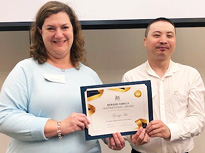
George Hu, Recipient of the Berger Family Inspirational Award. Pictured with Esther Chudy.

Sandeep Dani, Recipient of the Manny Mitchell Award for Excellence in Volunteerism. Accepted the award via video.

These stories remind us of the power of perseverance and community, and we are incredibly proud to share in their success. Once again, thank you to all who made the evening possible, and to our staff, volunteers, and supporters – your contributions make our mission possible.


JVS Toronto’s 2023-2024 Annual Report

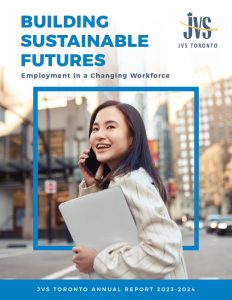
In this report, you’ll find inspiring stories like Perrier’s – a young entrepreneur from our Youth Entrepreneurship Program who came back to JVS Toronto to turn his passion into a successful barbershop. You’ll meet Mina, a newcomer and single mom who found a job in the competitive IT field, and Frank, a single father in his 60s who found joy working in a synagogue kitchen and giving back to his community. These stories show the heart of what we do – helping people find not just jobs, but build sustainable careers with resilience and hope. 

Read More In Our Annual Report


By Donna Chabot Filed Under: Career Voice: Blog, News & Highlights Tagged With: AGM, Annual General Meeting, awards, disabilities, Donors, employers, employment, entrepreneur, job search, newcomers, success stories, volunteers, youthjobs

July 24, 2024 2 Comments

Ask the Employment Specialist: Why Can’t I Keep a Job?

Drawing of a typewriter with the words "Dear Employment Specialist"Dear Joanna,

I have been fired three times from different organizations as an Event Coordinator. I’ve lasted for the probation period of three months. Afterwards, I am told by the managers that the fit is not good and am instructed to pack my belongings and leave on the spot.

Why is this happening to me? I have all of the qualifications, technical skills, core competencies and requirements for the job without a question. I meet my deadlines, and feedback from the event participants is glowing. Needless to say, these experiences are destroying my self-confidence. I would be grateful for your input on my situation before I secure another job offer and end up with the same endings.

Signed: Fired For No Reason (FFNR)


Dear FFNR,

I admire your honesty and effort to get to the bottom of this painful situation. According to a recent New York Times article by Susan Dominus, two of the core competencies and skills that employers are looking for are communication and collaboration. Many of my employers tell me that an employee is hired for his/her technical skills; but fired for his/her soft skills.

Even Virgin Company’s Richard Branson, in his recent article on LinkedIn about how he hires states that there is nothing more important for a business than hiring the right team. If you get the perfect mix of people working for your company, you have a far greater chance of success. He adds that the first thing he looks for when searching for a great employee is somebody with a personality that fits with the company culture. Concurring with most leading employers, Branson says that “Most skills can be learned, but it is difficult to train people on their personality. If you can find people who are fun, friendly, caring and love helping others, you are on to a winner.”

Consider the recommendations that Branson makes to employers: he suggests that considering the fact that within three months employees usually know the duties and responsibilities of a position, if an employer is satisfied with the personality of the new employee, then they should look at experience and expertise. He recommends that employers look for candidates with transferable skills: “team players who can pitch in and try their hand at all sorts of different jobs. While specialists are sometimes necessary, versatility should not be underestimated”.

Unfortunately employers do not need a reason to fire you unless you are in a unionised environment or employment contract, posits Alison Doyle on JobSearch.About.com. She presents top 10 reasons why employees are fired. Perhaps you can assess yourself honestly and evaluate your own experiences at your former places of employment:

  1. Lying on the resume or job application. Did you have the level of skills, qualifications and experience for the job?
  2. Not getting along with co-workers or management.
  3. Inappropriate posts on social media sites.
  4. Insubordination. Are you talking back to your manager? Are you showing any signs of anger at work at your team or manager?
  5. Stealing.
  6. Poor performance. This doesn’t sound like you from your letter above, but be honest with yourself — employees often overrate their performance.
  7. Damaging company property.
  8. Falsifying company records. Are you making serious mistakes in your work? Are your events missing significant logistics? Are you neglecting important details with the customers or event participants that you are overlooking? Have you received any feedback over the three months that you are, indeed, making mistakes?
  9. Drug or alcohol possession at work.
  10. Violating company policy. When you started working, did you review company policies and procedures and make sure you understood them as well as adhere to this? Typically, all companies have employee handbooks with this information; you can also ask the Human Resources department for clarification.

Sometimes there are cases of employees being wrongfully terminated. Getting fired can happen to anyone, including myself! You can get fired even when it’s not your fault. Given that you have been fired three times after the probation period is over, I would suggest that you have an honest talk with yourself and/or find an experienced employment counsellor to get some feedback on your work behaviour. I would do as soon as possible to prevent being fired again.

Best wishes for your next job,

Joanna

By Donna Chabot Filed Under: Career Voice: Blog Tagged With: being fired, employment, help me keep my job, job maintenance, keep my job, losing a job, why do i lose my job

July 24, 2024 1 Comment

Ask the Employment Specialist: Religious Accomodation

Drawing of a typewriter with the words "Dear Employment Specialist"Dear Joanna,

I am an observant Jew who wears his kippah all the time, including at the interview meeting. Also, I keep Shabbat and all of the Jewish holy days. I will be required to leave early on Fridays during the late fall and winter months, not to mention the weekdays that I will have to leave work early and even miss a few working days. I was recently interviewed by a leading company for a driver position, and did not get the job offer because many of the required shifts fell over Shabbat and holy days. I do however, feel that the interviewers discriminated against me because of my kippah. Needless to say, I didn’t get the job because they said I was unable to work the mandatory shifts.

I’m curious to know at which point of the job search process do you recommend that I discuss my religious accommodations?

Signed: Kippah Man


Dear Kippah Man,

Religious accommodations in the workplace is a hot topic on the Internet. According to the Ontario Human Rights Commission (OHRC)’s policy on accommodation of religious observances, a “job applicant’s religion cannot be used as a selection criterion for employment.”

Therefore, the OHRC states, “invitations to apply for employment and job application forms cannot contain:
1. questions about availability for work that are asked in a manner that reveals the applicant’s creed
2. questions designed to reveal that religious requirements may conflict with the prospective employer’s work schedules or workplace routines
3. inquiries as to religious affiliation, places of worship that are attended, or customs observed.”

The OHRC also discusses flexible scheduling for employees, once hired.The purpose of this measure is to allow a flexible work schedule for employees, or to allow for substitution or rescheduling of days when an employee’s religious beliefs do not permit him or her to work certain hours. For example, Seventh Day Adventists and members of the Jewish faith observe a Sabbath from sundown Friday to sundown Saturday. Observant members of these religions cannot work at these times.

Blogger Matt Youngquist on Career Horizons points out the complexity of religion, and the impact it can have on career choices and finding new work. Drawing on the following strategies suggested by Youngquist, as well as the perspective of our JVS Employment Counsellor (and Editor of this blog), Karin Lewis, I suggest you consider this:

1. Research the company.

Learn as much as you can about the business and job before applying. Read the website, their LinkedIn page and other social media to find out the hours, the flexibility and workplace culture, and anything you can about the company, prior to the application process and interview. If you learn that one of the “bona fide” job requirements is that a flexible shift work schedule is “considered reasonably necessary to the normal operation of a particular business”, and you will therefore, be expected to work on Shabbat and holy days, then you might wish to reconsider this job application. Try to find out if there is any flexibility with the shifts by identifying current employers for an information interview.

2. Consider whether you want to disclose in the job interview.

I have to admit that I have heard the occasional success story from clients who chose, after making an excellent impression during a job interview, to disclose their need for religious accommodations. In one case, the employer accommodated the Shabbat and Holy days schedule and hired the person for an IT position. In your case, if you are already in the interview room, I would present the hours you ARE available, rather than when you cannot work. Needless to say, you will not be able to work at this company if you cannot get this time off.

To establish trust with employers, it’s critical to come clean in the job interview about your needed accommodations with the work schedule, and to negotiate alternative ways to make up the time. If you are going to do so, Karin Lewis stresses that candidates must be crystal clear about the accommodations required as well as what you are willing to offer in place of this lost time. Lewis emphasizes the need to reiterate to the employer that you are willing to whatever it takes to do a great job!

3. Know your legal rights.

Employers cannot legally ask you direct questions about religion on a job application or during the interview process. There are some minor exceptions to this rule, but you will not be asked about your religion or accommodations regarding your faith. Youngquist adds that employers have a “don’t ask, don’t tell” policy: interviewers don’t ask about this subject, and candidates are not obligated to discuss their religion or accommodations. That’s one way to handle things.

4. Avoid risky territory.

Youngquist posits that being too candid about your religion (or proselytizing) can be damaging to your candidacy and hurt your chances of getting the job offer. If you are being interviewed with an organization and/or interviewer from a similar background, I still wouldn’t discuss the specific details of your religious philosophy or ritual practices, or any other personal matters, as this could cross into risky territory. Youngquist warns to avoid raising the faith issue pro-actively; only bring up the subject if it’s relevant to the job, or to a legal question where your beliefs “would be an integral part of your answer that you don’t want to leave out”. Don’t ask the interviewer about their particular beliefs, faith, or religion; if they choose to share this information voluntarily, that’s their decision, but you shouldn’t try to draw it out of them.

5. Job Search Basics.

Engage in a very targeted job search, by identifying lists of companies and hiring managers where you will be free to practice your religious observances. You can find this information out through speaking with employees of companies on the phone or through social media, building your professional network, attending employer events and job fairs, and being thorough in your analysis of the job descriptions and postings to which you are applying.

Joanna

By Donna Chabot Filed Under: Career Voice: Blog, News & Highlights Tagged With: creed, disclosure, Discrimination, employment, human rights, interview, jewish, karin lewis, OHRC, religion, religious accomodation

  • 1
  • 2
  • Next Page »

Jump-start Your Job Search

Sign up now to connect with a JVS Toronto employment expert.

Jump-start Your Job Search - Sidebar

Upcoming Events

Notice
There are no upcoming events.

JVS Toronto

For general inquiries, contact:
T: 416-787-1151
E: [email protected]

Find a Location

Toronto

  • Bathurst Finch Hub
  • Jane Finch
  • Scarborough
  • Toronto Centre
  • Tycos
  • Yonge and Sheppard
  • Keele and Finch

York Region

  • Markham
  • Vaughan

More Information

  • Careers at JVS Toronto
  • Customer Service Feedback
  • Privacy Policy
  • Accessibility at JVS Toronto
  • Terms of Use
  • JVS Insider Login

Follow Us

  • facebook
  • instagram
  • linkedin
  • youtube
  • x
Imagine Canada Trustmark JVS Toronto is accredited under Imagine Canada’s national Standards Program dedicated to operational excellence.
Imagine Canada Trustmark

Copyright © 2026 · JVS Toronto

Youth Career Launch Program

Youth Career Launch Program Registration Form

Because you are employed full-time, you are not eligible for this service.

Professional Engagement for Access to Careers (PEAC)

PEAC Contact Us
Are you an Ontario resident? *
PEAC is only open to residents of Ontario.

Newcomer Pathways into Skilled Trades

Newcomer Pathways into Skilled Trades

Newcomer Pathways into Skilled Trades
First
Last
Citizenship Status: *

Newcomer Pathways into Skilled Trades

Eligibility:

  • Open to Permanent residents, convention refugees, and protected refugees
  • Must have work experience outside Canada
  • Must meet the requirements to be licensed in Ontario
  • No CLB required

Road to Employment for Immigrant Women

Road to Employment for Immigrant Women
Do you currently live in Ontario? *
Thank you for your interest in JVS Toronto services. Since you are located outside Ontario, you are not eligible for this program. However, you are welcome to attend our free workshops and events. Review our Workshop and Events Calendar here.
Thank you for your interest in JVS Toronto services. Due to your Citizenship Status you are not eligible for this program. However, you are welcome to attend our free workshops and events. Review our Workshop and Events Calendar here.

Request Student placement application assistance

Please select a valid form.

Apply to be a volunteer

Application for Apply to be a volunteer
First
Last

Request Assistance Making a donation

Application for Request Assistance Making a donation
First
Last

Canada-Ontario Job Grant

Application for Canada-Ontario Job Grant
First
Last

Newcomer Youth: Connections for Success (NYCS)

NYCS
Are you a Permanent Resident or Convention Refugee? *
Are you between 15 and 18 years old? *

Youth Reach

YouthReach Contact Form
Are you currently in enrolled in school? *

Youth Entrepreneurship Program (YEP)

Application for Youth Entrepreneurship Program (YEP)
First
Last

TRIEC Mentoring Partnership

Application for TRIEC Mentoring Partnership
First
Last
So you currently live in Ontario? *

Recruitment for Equity, Accessibility and Diversity (READY)

READY Webpage Contact Form
Are you currently in enrolled in school? *
Do you currently live in Ontario? *

International Skills Applied for Geriatrics (ISAGE)

ISAGE Contact Form
Are you currently enrolled in school? *
Do you currently live in Ontario? *

Immigrant Professionals Leveraging Architectural Knowledge for New Opportunities (IPLAN)

Application for Immigrant Professionals Leveraging Architectural Knowledge for New Opportunities (IPLAN)
First
Last
Do you currently live in Ontario? *

Newcomer Youth: Connections for Success (NYCS)

NYCS
Are you a Permanent Resident or Convention Refugee? *
Are you between 15 and 18 years old? *

Building Unbiased and Inclusive Workplaces Leveraging Diversity (BUILD)

Building Unbiased and Inclusive Workplaces Leveraging Diversity (BUILD)
First
Last
Do you currently live in Onatrio? *

Canadian Workplace Communication

Canadian Workplace Communication
First
Last
Do you currently live in Ontario? *

Job Search Workshop for Newcomers

JSW
What kind of program would you like to attend?
Do you currently live in Ontario? *
Thank you for your interest in JVS Toronto services. Since you are located outside Ontario, you are not eligible for this program. However, you are welcome to attend our free workshops and events. Review our Workshop and Events Calendar here.
Thank you for your interest in JVS Toronto services. Due to your Citizenship Status you are not eligible for this program. However, you are welcome to attend our free workshops and events. Review our Workshop and Events Calendar here.

Youth – Our Future Initiative (YOFI)

Application for Youth – Our Future Initiative (YOFI)
First
Last

Disability Services

Please select a valid form.
TRIEC Mentoring Partnership Eligibility Requirements

You should sign up for the program if you:

  • Have 2+ years of international experience in your professional field
  • Have lived in Canada for less than five years
  • Are unemployed or underemployed and looking to use your professional skills in Canada
IPLAN PRACTICE Eligibility Requirements
  • Open to Permanent Residents, Canadian Citizens, or Convention Refugees
  • High level of English-language proficiency (CLB 7/8). Enhanced language training is available to applicants, if needed, prior to starting the program
  • Degree in architecture from a university outside Canada
  • OAA Intern Architects eligible to write the Examination for Architects in Canada (ExAC)**


*Note:

  • The practice of architecture in Ontario is governed by the Ontario Association of Architects (OAA). All individuals who are internationally trained in the field of architecture, or who have held the status of architect in another jurisdiction must contact the OAA or visit the OAA website at www.oaa.on.ca for current information about licensing requirements and the licensing process in Ontario.
  • JVS Toronto is not a licensing body in Ontario.
  • The Canadian Architectural Certification Board (CACB) is the sole organization recognized by the architectural profession in Canada to:
    • Assess the educational qualifications of architecture graduates;
    • Accredit professional degree Programs in architecture offered by Canadian Universities; and
    • Certify the professional qualifications of Broadly Experienced Foreign Architects.
  • Architectural services may only be offered through a Certificate of Practice issued by the OAA.

**The content of this program has not been reviewed or endorsed by the Committee for the Examination for Architects in Canada (CExAC). The ExAC is an experience based exam. It is the practical application of knowledge acquired through education and readings that will support examination success. Taking this program without applying the knowledge gained through practice may not result in examination success.