JVS Toronto

DONATE
  • About
    • Our Leadership
    • Our Funders & Donors
    • Annual Reports & Financials
    • Service Interruption Notices
    • FAQs
  • Find a Job
    • Career Development and Job Search Support
    • Disability Services
      • RiseAbility
    • Jewish Community Services
    • Newcomer Services
    • Youth Services
    • Job Search Resources
    • Hiring Events
  • Events
    • Hiring Events
    • Interview Skills
    • Job Search Skills
    • LinkedIn Tips
    • Networking & Info Sessions
    • Newcomers
    • Resume Help
    • Youth Events
  • Employers
  • Pre-Arrival
  • Give Back
    • Donate
    • Volunteering and Mentoring
  • Blog
  • Contact

October 15, 2018 4 Comments

How do I deal with the lack of Canadian work experience during a job interview?

Portrait of pensive Asian businesswoman wearing costume standing in office holding coffee cup and looking out windowThe lack of Canadian experience is the most commonly identified barrier identified by newcomers as they pursue meaningful work in their new country; many report that they continue to face this challenge even after two or more years of living in Canada. In response to complaints about these demands from job seekers, in 2013 the Ontario Human Rights Commission (OHRC) added requirements for Canadian experience to the Ontario Human Rights Code as a discriminatory practice. The Code covers a range of hiring practices, including asking about race, ancestry, place of origin, colour, ethnic origin, citizenship, creed, sex, sexual orientation, gender identity, gender expression, age, record of offences, marital status, family status or disability.

The Commission require employers to make hiring decisions without violating the Ontario Human Rights Code. In their publication, Human Rights at Work , under Interviewing and Making Hiring Decisions the OHRC details what employers should avoid asking; this includes questions based on:

  • Presence or absence of Canadian experience
  • Landed immigrant status, permanent residency, naturalization or refugee status
  • Place of birth
  • Affiliation with a particular “community” or where the applicant “comes from”
  • Membership in organizations such as cultural or ethnic associations
  • Name and/or the applicant’s appearance
  • Name and location of schools attended

What should I do if asked a question that is discriminatory in nature?

Job seekers facing this question in an interview can consider these options:

  • Answer the question – Weigh the pros and cons of this approach and the risk of it affecting your chances of being hired. It is your right to disclose whatever information you want to the employer.
  • Refuse to answer – This option could create tension between you and the interviewer. Decide if this is an important principle to you. If so, would you want to work for an employer that asks such questions?
  • Inform the interviewer that the question they asked does not comply with the Ontario Human Rights Code – The interviewer may not be aware of this fact, have improperly phrased their question, or are concerned about your availability or ability to do the job.

Keep in mind that how you answer a question will make a big difference to the employer’s decision to keep the interview going. Using the right tone of voice and phrasing can also keep the interview moving in a positive direction.

Start by giving the employer the “benefit of the doubt” and they didn’t realize that their question could be perceived as discrimination. Try something like : “You might not know this, but that question violates the Ontario Human Rights Code. I am sure you’ will understand if I prefer not to answer it. I can assure you, though, that my (health/family situation/life circumstances) will not impact on my ability to do the job. You are welcome to speak to my references who can speak to my high work ethic and dedication.”

When the lack of Canadian work experience comes up in the interview, consider:

  • Preparing for the interview by researching this type of position in Canada and local industry terms, acronyms and related protocols that are typically used. Use these terms during the interview.
  • Reassuring employers that you have the skills and abilities described in the job posting. Offer examples of how you’ve used such skills in past positions.
  • Ask the employer about the kind of experience they are looking and describe job tasks that you have that address demonstrate this experience.
  • Show an openness and willingness to learn for any areas where you have limited experience.

As a job seeker, know your rights that are outlined in the Ontario Human Rights Code, understand the role of the Ontario Human Rights Commission, and what to do if you believe your rights have been violated.

Need more help?

JVS Toronto provides specific employment programs for immigrants and newcomers to Canada to help them navigate the challenges and be successful at securing a job. Find out more: Newcomer Services – Prior to Arriving in Canada

Newcomer Services – after arriving in Canada.

By Karin Lewis Filed Under: Career Voice: Blog Tagged With: canadian experience, find job, illegal questions in Canada, interview, interviewing, newcomer, ontario human rights code

October 1, 2018 Leave a Comment

Struggling to make a career decision? Try this helpful tool.

Thoughtful man with question symbols behind
Making a career decision is difficult at any stage of life. When you are finishing school and have to decide, it’s hard to sort through all the options and possibilities. But it is even more difficult when you are an adult, possibly with family responsibilities, perhaps in the new country where you still don’t have all the information you need, and facing the financial pressures that come with having to settle into a new place.

There are many factors to consider. Would this career choice allow you to earn enough to support your financial goals? Are jobs plentiful in this field? Will the job be fulfilling and meaningful? Are there opportunities for promotions and career growth? Will it allow you the work-life balance you need? Not only are there multiple factors, but the question is whether all these factors really matter to you equally. Perhaps work-life balance is more important to you than salary or career growth, whereas others might prioritize earning potential. Given everything involved, it isn’t easy to make a rational choice.

The Decision-Matrix Method, or Pugh Method, is a weighted decision matrix, allowing you to weigh the factors that are important in your decision against each other when making your choice. Thus it can help you think more rationally through all the factors you need to consider.

This is how it works. Try it for yourself.

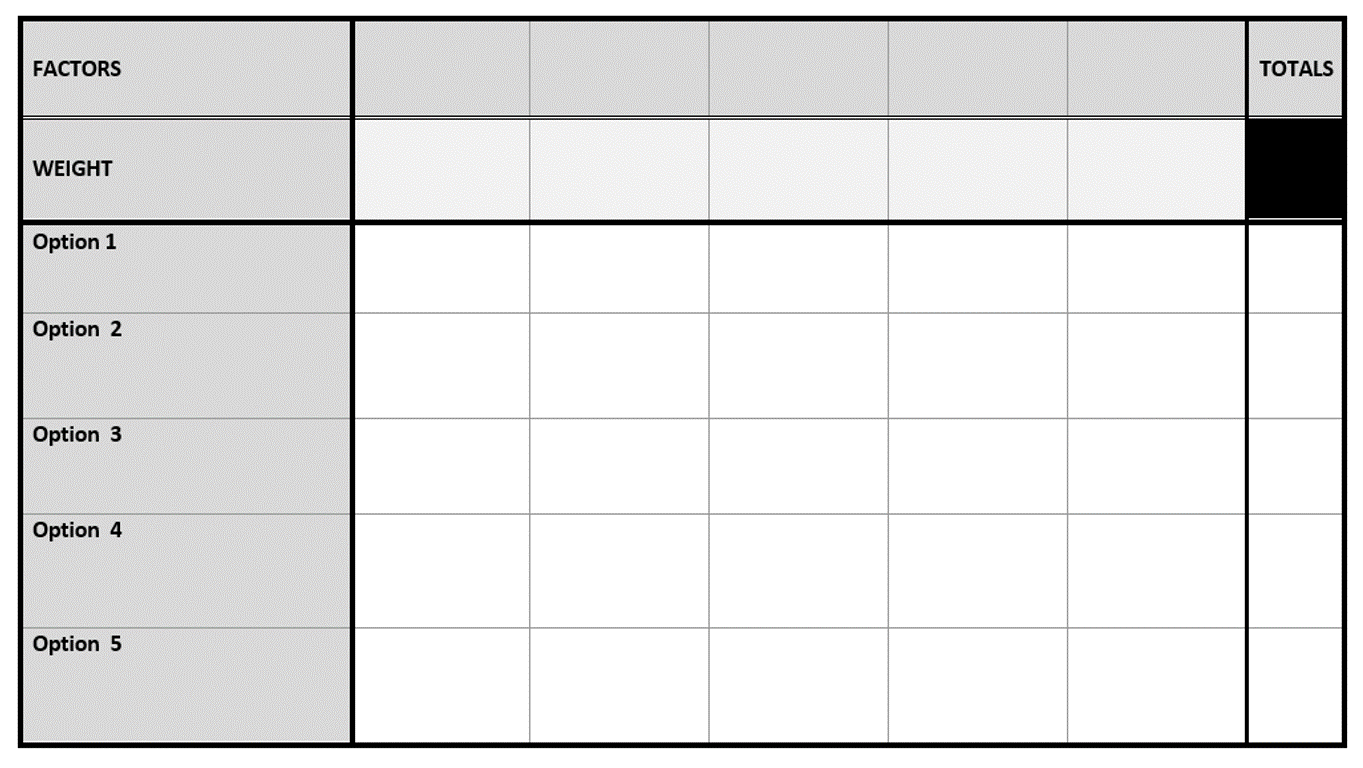
Draw a table with up to seven rows and six columns, like this:
Blank matrix
Next, complete the following steps:

  1. First, list all of the career options that you are considering as rows in the lefthand column.
  2. Next, list five factors you need to consider, as column headings across the top. Factors may include salary, travel time, meaningfulness, work-life balance, etc.
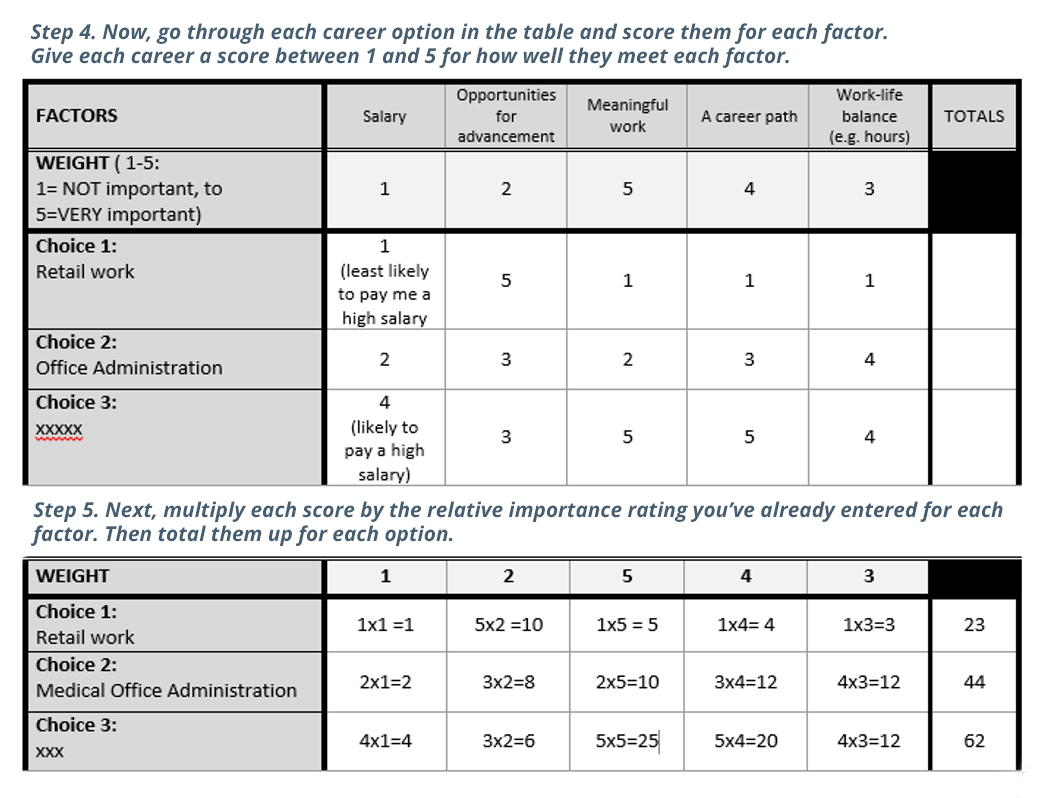
  3. Rate the relative importance of each factor for you, scoring them from 1 (not important) to 5 (most very important). For example, if meaningful work is more important to you than work-life balance, give it a 5, and work-life balance a 4. There is no right or wrong rating — it is completely up to your personal preferences.
  4. Now, go through each career option in the table and score them for each factor. Give each career a score between 1 and 5 for how well they meet each factor. For example, how are you going to earn the salary you want working in that career? How likely are you to have opportunities for advancement? You might need to do some research into your career choices to gather this information. Conduct a job search using Google to gather information about the jobs in your careers of interest.
  5. Next, multiply each score by the relative importance rating you’ve already entered for each factor. Then total them up for each option.

Populated matrix

When you’ve completed this last step, the option with the highest score will be your best choice.

Is it what you expected? If not, why?

Still stuck? JVS Toronto offers Career Exploration Coaching. Our certified counsellors will identify your skills and interests, and uncover the career path that will make you feel happy, successful and fulfilled.

By Karin Lewis Filed Under: Career Voice: Blog Tagged With: Career Exploration, career-decision-making, decision making matrix

September 17, 2018 Leave a Comment

Are Cover Letters Really Needed?

Smart Phone Using E-mail Online Messaging ConceptJob seekers often tell me that writing a cover letter is the most tedious aspect of the entire job search process. Maybe writing letters just doesn’t come easily for people, because it isn’t something we often do anymore. Even worse, employment professionals such as myself keep telling job seekers to write individualized (non generic) letters, so it takes extra time and effort to prepare one.

But I think it is still needed. First impressions do count. Employers often get a huge number of applications to the jobs they post, so they have to be picky and quick to exclude applicants that haven’t made a proper effort to apply.

As employers sort through applications, they are hoping to find those candidates that appear well qualified, likable and competent enough to be invited for an interview. Cover letters give employers a chance to gather that information and learn more about the personality, writing style, language and grammar of the applicant. A candidate who can show that they have carefully read the job posting, and express how they meet the requirements outlined, is also showing employers how well they pay attention to detail and follow instructions.

How to write an effective cover letter?

A cover letter is a brief, one-page document that accompanies a resume, introduces the candidate, and motivates the employer to read the resume and consider the candidate for a position. It should help employers see how their needs (their described “qualifications” on the posting) are matched by the candidate. In effect, it’s a way of saying to the employer: I have the skills, experience and personality that you are looking for.

You can do that by indicating that you have read the job posting and understand the expectations of the employer:

  • show your interest and enthusiasm
  • introduce your resume — identify what parts of your resume are most relevant to the job
  • show off your excellent writing skills, grammar, and spelling
  • indicate to the employer that you can and will follow instructions by applying exactly the way the employer requested in the job ad/posting

Cover letters should accompany almost any resume, whether it is in response to a posting, is solicited (i.e. the employer asked you to send them a resume), or even unsolicited (i.e. you are sending the resume to employers, in case they are hiring).

Check your cover letter against this checklist of “do’s” and “don’ts”:

  1. Follow the instructions in the posting, making sure to submit it in time and to the specific person outlined in the advertisement
  2. Keep the letter short, simple and easy to read
  3. Don’t use a generic cover letter; write a unique and personalized letter for each employer
  4. Use a formal tone, but show the level of enthusiasm that is suitable to the type of position to which you are applying
  5. Match the format of the letter to your resume, in terms of the font and “letterhead” (i.e. the format you use for your name and address)
  6. Don’t forget to include the specific job title as identified in the job posting, including any reference numbers provided by the employer
  7. Make sure to mention where you found the job posting
  8. Describe yourself to the employer; reference the specific qualifications requested in the posting; don’t assume that the employer will read your resume unless they find what they need in the cover letter
  9. Before sending it, always check your spelling and grammar very carefully
  10. Don’t depend on spell-check — it will only pick up some errors, not all (it won’t pick up a mistake if it is a real word — for example, it won’t pick up using “form” instead of “from”)

For samples of cover letters, check out some of my favourite websites such as Workbloom, Monster.ca and The Balance — Careers.

It is worth investing time and effort to write a high quality letter which conveys your enthusiasm and shows the employer the exact reasons they should consider you for the position. Capturing the interest of the employer can be a deal breaker — if your cover letter does not impress, the employer will probably not read your resume or call you for an interview, whereas a well-worded, thoughtful letter can go a long way toward helping you get that next great opportunity.

By Karin Lewis Filed Under: Career Voice: Blog Tagged With: cover letter, job search advice

September 14, 2018 Leave a Comment

Your Credit Score in Canada: Tips for managing finances and maintaining a good score

House, stacked coins and calculator sitting on a tableYour credit score matters. Building a good credit history is important because lenders will check your credit score to determine whether to approve you for things like cell phone plans, housing, cars, and lines of credit. In this webinar, money expert Yingshuo Liu, Financial Advisor at Scotiabank, walks us through:

  • What is credit score?
  • Factors that affect credit score
  • Tips on building credit score – credit cards, utility bills, multiple sources of credit etc.
  • Impact of poor credit
  • Credit history from other countries
  • Maintaining credit score before finding employment and after

[Read more…]

By Donna Chabot Filed Under: Career Voice: Blog

September 3, 2018 Leave a Comment

Impress Employers with Well Prepared Interview Answers

Smiling colleagues discussing working ideas in officeFacing an employer in a job interview is often described as the most stressful and intense moment in the process of finding work. When asked what they fear most about interviews, job searchers often say that they worry that they may get overwhelmed by anxiety and forget what they want to say, or that they may not be able to answer a question properly.

Of course, the only way to deal with this anxiety is by preparing and working on some of the commonly asked questions. In addition to preparing answers to questions, you should be ready to talk about yourself by sharing examples of your achievements from your past jobs. These will serve to demonstrate your skills and prove your competency. It will help the employer to picture you in the workplace. When an interview has concluded, likely, candidates will most likely be remembered by the interesting stories or anecdotes they shared.

To identify your best stories, think back to your past jobs. Think of accomplishments or events which challenged you or which allowed you to demonstrate your abilities. Consider including the feedback you received for these achievements. Keep in mind that stories do not have to portray you as perfect – situations are more likely to be believable and credible if they include times when you made mistakes and learned from them.

Your stories might include a time when you:

  • lead a project from beginning to completion
  • identified a problem/gap in service and took initiative to solve it
  • were given responsibility to represent your company in a public event
  • dealt with an unhappy or difficult customer
  • assisted a colleague with a problem
  • developed and applied expertise in a particular area
  • went above and beyond the usual demands of your job to contribute to the company
  • did something really well

Keep in mind that to sustain the listener’s attention and be memorable, you need to plan your stories carefully. Make sure that examples are structured with a beginning, middle, and end:

  1. Begin with a brief context or setup – where and when did the incident/event happen?
  2. Describe what happened and why was it important — what was YOUR role/action?
  3. End off with a description of how the issue was resolved (what was the outcome?)

These stories have to be short but should include enough detail to allow the employer to visualize the situation. Most importantly, make sure they are directly relevant to the position for which you are interviewing.

Write up and practice saying your stories out loud. Ask an employment professional or even a friend for feedback; let their impressions and questions guide you to improve the length, clarity, details and relevance of the story.

Once they are complete, try to figure out which skills each story demonstrates. Each example may demonstrate several skills such as your ability to make decisions, work in a team, solve problems, take initiative, be responsible or flexible, and many other skills. Identify those which you would like to “show off” to employers. A good anecdote can often demonstrate multiple skills or strengths and can be told differently depending on what you are trying to demonstrate. If you can talk in a relaxed and comfortable way, storytelling can become a very effective tool to market yourself. You will be demonstrating your communication skills, as well as having an opportunity to show the best of what you have achieved in your work history.

Read this guide for more ways to develop your storytelling abilities. Make sure to watch the video included in the post for more tips on effective storytelling in interviews.

By Karin Lewis Filed Under: Career Voice: Blog Tagged With: behavioural interviewing, interview questions, interview tips, interviewing, job interview

  • « Previous Page
  • 1
  • …
  • 22
  • 23
  • 24
  • 25
  • 26
  • …
  • 63
  • Next Page »

Jump-start Your Job Search

Sign up now to connect with a JVS Toronto employment expert.

Jump-start Your Job Search - Sidebar

Upcoming Events

Mar 10
10:00 am - 12:30 pm

Resumes & Cover Letters

Mar 10
Featured 10:00 am - 3:00 pm

FirstService Residential Hiring Event

Mar 10
Featured 11:00 am - 12:00 pm

ISAGE Info Session

Mar 10
5:00 pm

Allstate Hiring Event Deadline

View Calendar

JVS Toronto

For general inquiries, contact:
T: 416-787-1151
E: [email protected]

Find a Location

Toronto

  • Bathurst Finch Hub
  • Jane Finch
  • Scarborough
  • Toronto Centre
  • Tycos
  • Yonge and Sheppard
  • Keele and Finch
  • Albion

York Region

  • Markham
  • Vaughan

More Information

  • Careers at JVS Toronto
  • Customer Service Feedback
  • Privacy Policy
  • Accessibility at JVS Toronto
  • Terms of Use
  • JVS Insider Login

Follow Us

  • facebook
  • instagram
  • linkedin
  • youtube
  • x
Imagine Canada Trustmark JVS Toronto is accredited under Imagine Canada’s national Standards Program dedicated to operational excellence.
Imagine Canada Trustmark

Copyright © 2026 · JVS Toronto

Youth Career Launch Program

Youth Career Launch Program Registration Form

Because you are employed full-time, you are not eligible for this service.

Professional Engagement for Access to Careers (PEAC)

PEAC Contact Us
Are you an Ontario resident? *
PEAC is only open to residents of Ontario.

Newcomer Pathways into Skilled Trades

Newcomer Pathways into Skilled Trades

Newcomer Pathways into Skilled Trades
First
Last
Citizenship Status: *

Newcomer Pathways into Skilled Trades

Eligibility:

  • Open to Permanent residents, convention refugees, and protected refugees
  • Must have work experience outside Canada
  • Must meet the requirements to be licensed in Ontario
  • No CLB required

Road to Employment for Immigrant Women

Road to Employment for Immigrant Women
Do you currently live in Ontario? *
Thank you for your interest in JVS Toronto services. Since you are located outside Ontario, you are not eligible for this program. However, you are welcome to attend our free workshops and events. Review our Workshop and Events Calendar here.
Thank you for your interest in JVS Toronto services. Due to your Citizenship Status you are not eligible for this program. However, you are welcome to attend our free workshops and events. Review our Workshop and Events Calendar here.

Request Student placement application assistance

Please select a valid form.

Apply to be a volunteer

Application for Apply to be a volunteer
First
Last

Request Assistance Making a donation

Application for Request Assistance Making a donation
First
Last

Canada-Ontario Job Grant

Application for Canada-Ontario Job Grant
First
Last

Newcomer Youth: Connections for Success (NYCS)

NYCS
Are you a Permanent Resident or Convention Refugee? *
Are you between 15 and 18 years old? *

Youth Reach

YouthReach Contact Form
Are you currently in enrolled in school? *

Youth Entrepreneurship Program (YEP)

Application for Youth Entrepreneurship Program (YEP)
First
Last

TRIEC Mentoring Partnership

Application for TRIEC Mentoring Partnership
First
Last
So you currently live in Ontario? *

Recruitment for Equity, Accessibility and Diversity (READY)

READY Webpage Contact Form
Are you currently in enrolled in school? *
Do you currently live in Ontario? *

International Skills Applied for Geriatrics (ISAGE)

ISAGE Contact Form
Are you currently enrolled in school? *
Do you currently live in Ontario? *

Immigrant Professionals Leveraging Architectural Knowledge for New Opportunities (IPLAN)

Application for Immigrant Professionals Leveraging Architectural Knowledge for New Opportunities (IPLAN)
First
Last
Do you currently live in Ontario? *

Newcomer Youth: Connections for Success (NYCS)

NYCS
Are you a Permanent Resident or Convention Refugee? *
Are you between 15 and 18 years old? *

Building Unbiased and Inclusive Workplaces Leveraging Diversity (BUILD)

Building Unbiased and Inclusive Workplaces Leveraging Diversity (BUILD)
First
Last
Do you currently live in Onatrio? *

Canadian Workplace Communication

Canadian Workplace Communication
First
Last
Do you currently live in Ontario? *

Job Search Workshop for Newcomers

JSW
What kind of program would you like to attend?
Do you currently live in Ontario? *
Thank you for your interest in JVS Toronto services. Since you are located outside Ontario, you are not eligible for this program. However, you are welcome to attend our free workshops and events. Review our Workshop and Events Calendar here.
Thank you for your interest in JVS Toronto services. Due to your Citizenship Status you are not eligible for this program. However, you are welcome to attend our free workshops and events. Review our Workshop and Events Calendar here.

Youth – Our Future Initiative (YOFI)

Application for Youth – Our Future Initiative (YOFI)
First
Last

Disability Services

Please select a valid form.
TRIEC Mentoring Partnership Eligibility Requirements

You should sign up for the program if you:

  • Have 2+ years of international experience in your professional field
  • Have lived in Canada for less than five years
  • Are unemployed or underemployed and looking to use your professional skills in Canada
IPLAN PRACTICE Eligibility Requirements
  • Open to Permanent Residents, Canadian Citizens, or Convention Refugees
  • High level of English-language proficiency (CLB 7/8). Enhanced language training is available to applicants, if needed, prior to starting the program
  • Degree in architecture from a university outside Canada
  • OAA Intern Architects eligible to write the Examination for Architects in Canada (ExAC)**


*Note:

  • The practice of architecture in Ontario is governed by the Ontario Association of Architects (OAA). All individuals who are internationally trained in the field of architecture, or who have held the status of architect in another jurisdiction must contact the OAA or visit the OAA website at www.oaa.on.ca for current information about licensing requirements and the licensing process in Ontario.
  • JVS Toronto is not a licensing body in Ontario.
  • The Canadian Architectural Certification Board (CACB) is the sole organization recognized by the architectural profession in Canada to:
    • Assess the educational qualifications of architecture graduates;
    • Accredit professional degree Programs in architecture offered by Canadian Universities; and
    • Certify the professional qualifications of Broadly Experienced Foreign Architects.
  • Architectural services may only be offered through a Certificate of Practice issued by the OAA.

**The content of this program has not been reviewed or endorsed by the Committee for the Examination for Architects in Canada (CExAC). The ExAC is an experience based exam. It is the practical application of knowledge acquired through education and readings that will support examination success. Taking this program without applying the knowledge gained through practice may not result in examination success.